+

We can see you are located in UK, you might want to checkout the site in English!

Take me there!

Airport Belt Loaders

What is an Airport Belt Loader?

An airport belt loader is an essential ground support equipment (GSE) used for the efficient loading and unloading of baggage, cargo, and mail onto and off aircraft. These vehicles are designed with a conveyor belt system that transport items from the loader to the aircraft cargo hold.

Belt loaders play a key role in reducing aircraft turnaround time, increasing operational efficiency, and assisting ground handling staff in the baggage and cargo handling process of bulk loaded aircraft. They are available in self-propelled and towable configurations, suitable for different aircraft types and airport environments. Self-propelled belt loaders have 2 main categories: conventional and extendable versions. Modern belt loaders also incorporate automation and advanced safety features to enhance operational reliability.

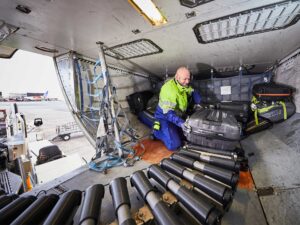
Power Stow´s extendable belt loader system, the Rollertrack Conveyor, reaches inside the aircraft's cargo hold, makes the 90° turn and delivers bags to the ramp agent inside. This advanced belt loader technology provides enhanced working conditions for ramp agents inside the aircraft hold, whilst improving productivity and reducing baggage handling times.
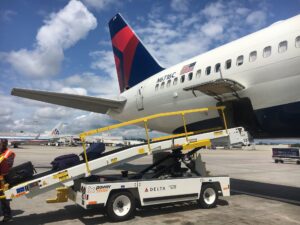
Power Stow belt loader - Delta

How are conventional belt loaders used at airports?

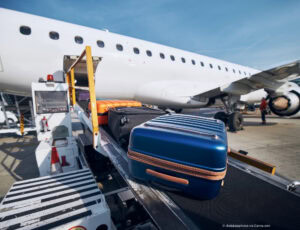
Conventional belt loaders are positioned next to the aircraft’s cargo doors, allowing ground handlers to transport baggage and cargo between the ground and the aircraft hold. The process typically involves the following steps:

  • Positioning: The belt loader is driven or towed to the aircraft and aligned with the cargo door.
  • Height Adjustment: The conveyor belt height is electronically or hydraulically adjusted to match the height of the cargo door. During the handling process, operators typically perform additional manual adjustments to ensure precise positioning.
  • Loading/Unloading: Ground crew places baggage onto the conveyor belt, which transports the items between the rear end of the belt loader and the aircraft door sill, depending on whether loading or unloading is taking place. At both ends — at the rear of the belt loader and inside the cargo hold — handlers manually handle bags and cargo, which involves lifting, pushing, and stacking of items.
  • Completion: Once loading or unloading is completed, the belt loader is removed, and the aircraft is ready for further ground operations or departure.
Conventional airport belt loader

How are extendable belt loaders used at airports?

  • Approaching the aircraft: The operator approaches in the same way as with a conventional belt loader.
  • Docking on aircraft: The operator places the specially designed Flexramp onto the door sill of the aircraft. Once in contact with the floor of the aircraft, the computer controlled Auto-levelling system takes over, as the aircraft moves up and down the Auto-levelling feature of the Power Stow unit follows the aircraft.
    If the unit is equipped with Power Stow’s Assisted Docking System, the approach and docking process is further supported by automated guidance features that assist the operator throughout the procedure.
  • Loading/Unloading: The Rollertrack is easily extended into the aircraft hold by actuating one of the two handles located on either side of the loading head. It extends along the floor all the way to the bulkhead of most narrow-body aircraft. The system automatically transports the items to the operator, positioned at the end of the cargo compartment, who then places the bags in position with ease using the height-adjustable loading head. When unloading, the process is simply reversed. The system enables airport ground handlers to load and unload bulk baggage and cargo faster and more efficiently, while significantly reducing the physical strain on the ground handling staff.
  • Completion: Once loading or unloading is complete, the Rollertrack is retracted, and the Flexramp is removed from the aircraft door sill. The unit can then be safely and quickly moved away from the aircraft.
Baggage handling with Power Stow extendable belt loader

Key features to look for in an airport belt loader

Selecting the right belt loader for airport operations requires a detailed assessment of several technical aspects to ensure optimal performance and compliance with industry standards. Some of the most critical features include:

  • Conveyor belt length & adjustability – The belt must be long enough to reach different aircraft types, with height adjustments that provide seamless alignment with varying cargo door positions.
  • Drive system & power options – Belt loaders are available in non-motorized, electric, diesel, gasoline, LPG, hydrogen and hybrid variants allowing operators to choose based on environmental policies, energy efficiency, and ground handling logistics.
  • Load capacity & conveyor strength – High-torque motors and reinforced conveyor belts ensure the operator can handle heavy loads while maintaining smooth movement and speed control.
  • Ergonomics & operator safety
    • Rollertrack extendable belt loading system – The Power Stow Rollertrack Conveyor is an innovative solution that enhances baggage handling by extending the conveyor directly into the aircraft hold. This semi-automated system greatly reduces physical strain on baggage handling staff, improves efficiency and offers a lean operation with optimized teams. The Rollertrack system is compatible with four different belt loader brands.
    • Tail Loader – The Tail Loader is an ergonomic lifting device mounted at the rear end of the belt loader. It can be extended, raised or lowered, and moved sideways to bridge the gap between the baggage cart or ULD and the belt loader, enabling a more ergonomic and streamlined baggage handling process. The Tail Loader is compatible with any Power Stow supported chassis.
  • Safety systems & operator controls – Modern belt loaders can be equipped with features such as:
    • Aircraft damage prevention system
    • Emergency stop buttons at multiple access points
    • Safety rails and sensors around the conveyor belt
    • Auto-level system
    • Adjustable belt speed
  • Reliability and Operational Durability – Designed for maximum uptime and consistent performance, even under the most demanding conditions.
  • Weather resistance & durability – Given that belt loaders operate in harsh environments, heavy-duty components and anti-corrosion coatings ensure reliability and longevity.
  • Integration with Ground Handling IT Systems – Some belt loaders feature connectivity options for fleet management systems, allowing real-time tracking, usage monitoring, and predictive maintenance alerts.

Belt loader brands & Rollertrack compatibility

Several manufacturers produce high-quality belt loaders, each offering unique features and capabilities.
Additionally, the Power Stow Rollertrack Conveyor can be implemented on four belt loader brands.

MULAG

MULAG is a German manufacturer known for its high-precision engineering and robust construction. The Rollertrack Conveyor can be integrated into MULAG Orbiter models in diesel and electrical versions.

TIPS

TIPS is a Slovenian producer of high-quality and technologically perfected aircraft ground support equipment. The TIPS Pulley diesel and electrical belt loaders are compatible with the Rollertrack Conveyor system.

TLD

TLD is a leading global manufacturer of a wide range of ground support equipment. Their belt loader models are built for durability and operational flexibility. The NBL electric and diesel belt loader models are compatible with Power Stow Rollertrack.

TUG (Textron GSE)

TUG belt loaders, part of Textron GSE, are widely used in North America and are known for their rugged build and long service life. Their diesel, gas and electric models are available with Power Stow´s Rollertrack system.

Enhanced working conditions and improved efficiency

Airport belt loaders are essential components of ground handling operations, ensuring fast, safe, and efficient baggage and cargo transport. The Power Stow Rollertrack Conveyor offers a significant advantage by minimizing manual baggage handling, enhancing working conditions, improving efficiency, and reducing turnaround times. By investing in Power Stow´s advanced belt loader solution, airports, airlines and ground handling companies can enhance efficiency, improve safety, achieve higher operational performance and ensure a leaner baggage handling process.

baggage handler

Follow our journey on WeChat

Find more stories, news and videos about Power Stow on our official WeChat account.